Five Months Later: What I Actually Built with AI

On 21 February, I published a post about what I had been building with artificial intelligence.
I ended it with a fairly specific intention:
“The next stage is structured progress tracking.”
Then I stopped writing.
This was not because I had lost interest in AI. The more mundane explanation is that maintaining two websites felt like one website too many. ESHEETS was growing, there was always something else to fix, and writing about the work kept losing out to doing the work.
Five months later, it seems reasonable to check whether I ever built that progress-tracking system.
I did.
From worksheets to a homework system
At the time of my last post, ESHEETS was mainly a collection of interactive maths worksheets. Students could answer questions, receive immediate feedback and generate more practice without waiting for somebody to mark a piece of paper.
That part worked well, but each worksheet was still largely an isolated activity. A student could complete it and see a score, but the result did not go anywhere useful.
The new teacher portal changes that.
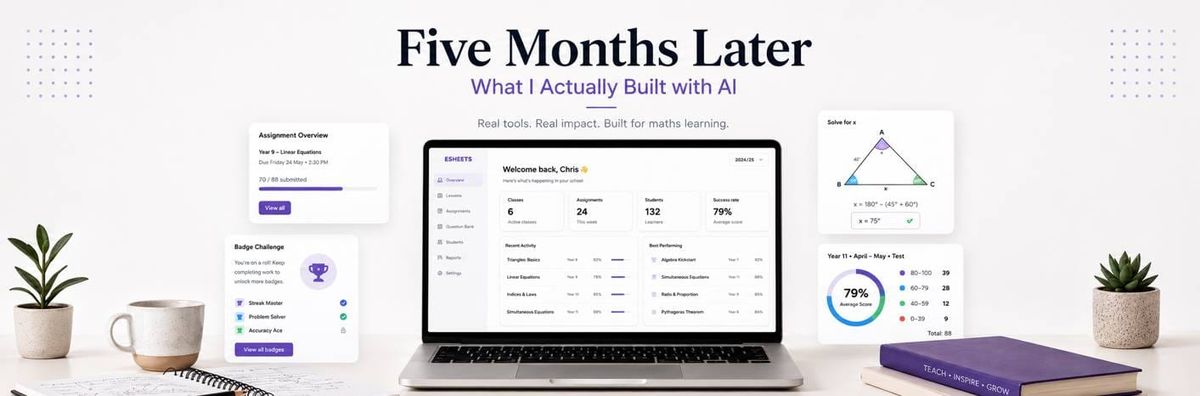
A teacher or tutor can now create a class, choose a worksheet and generate a short task code. Students enter the code, complete the activity and submit their results. The teacher can then see who has attempted the work, what they scored and whether they have subsequently improved.
There are no student accounts to create and no passwords for children to forget. Results can be filtered and exported, and personal-best scores are recorded alongside the latest attempt.
It is not intended to replace the large platforms used by schools. It is a much smaller system for teachers and private tutors who want to set a piece of interactive maths work and see what happened afterwards.
In other words, it is more or less the thing I said I wanted to build in February.
AI did not build it while I made a cup of tea
Descriptions of AI-assisted development often skip the untidy middle.
You describe an idea to an AI model. Some code appears. The music swells. A fully functioning technology company emerges before lunchtime.
That has not been my experience.
AI has written a considerable amount of code for ESHEETS, but the difficult part is rarely producing the first version. The difficult part is deciding exactly what the system should do.
Should students need accounts? How should teachers identify them? What happens when two students enter the same name? How long should results be stored? What should happen when a class is archived? Can the whole thing be used comfortably on an iPad? What happens when somebody refreshes the page halfway through?
These decisions are not especially glamorous, but they determine whether a classroom tool is useful or merely impressive in a screenshot.
There have also been failed deployments, database problems, broken layouts and features that worked perfectly until an actual person tried to use them. AI helps me understand and repair these problems, but it does not prevent me from creating them.
My role is still to decide what is worth building, test it in realistic conditions and notice when the proposed solution is technically clever but educationally daft.
More than 200 worksheets
The underlying collection has continued to grow as well.
ESHEETS now contains more than 200 self-marking maths worksheets, organised across the main GCSE curriculum areas. Recent additions have included probability trees, probability scales, two-way tables, composite bar charts, sectors, equations with unknowns on both sides and graphical solutions of quadratics.
The more important development, however, has been behind the scenes.
The worksheets increasingly use a shared framework rather than each page behaving like a separate miniature website. This means improvements to scoring, printing, navigation and mobile layouts can be made across the collection instead of being repeated manually on hundreds of pages.
This is one of the less visible benefits of working with AI. It becomes possible to tackle the tedious structural jobs that a lone developer might otherwise continue avoiding for several years.
I still avoid some of them, naturally. Just fewer than before.
Games, simulations and visual tools
The site has also moved beyond conventional worksheets.
I have built mathematical visualisation tools, including one for exploring the ambiguous case of the sine rule. Students can alter a triangle and see why the same information can sometimes produce two possible answers.
Other tools explore geometrical situations such as a sheep tethered to a building or attached to a sliding ring. These are fairly niche things to build, which is precisely why AI helps. A visual idea that might once have been too time-consuming to justify can now be tested relatively quickly.
I have also produced larger classroom activities.
Trip Tycoon asks students to manage the budget for a school trip over several days. Bills & Buffers gives them an income and requires them to survive three months of rent, bills, subscriptions and unexpected expenses. And Zoo Mogul (where you design and operate a for-profit zoo) remains the most popular.
These began as activities for financial-literacy lessons at school. They are not attempts to disguise ten arithmetic questions with a picture of a wallet. The decisions, consequences and uncertainty are part of the mathematics.
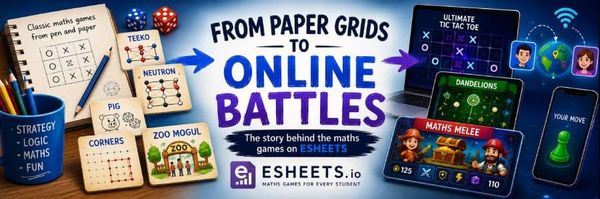
There are multiplayer games too, including Maths Melee, along with puzzles and end-of-term activities. Some have attracted considerably more search traffic than I expected. Dandelions, a small strategy game that I nearly regarded as an eccentric side project, remains strangely popular.
The internet has its own judgement.
Being noticed by Resourceaholic
Another encouraging moment came in July when ESHEETS was featured by Jo Morgan on Resourceaholic.
Resourceaholic is a well-known and widely used website among secondary maths teachers. ESHEETS appeared in its 200th Maths Gems post alongside established resources including MathsPad and materials from the NCETM.
Jo highlighted the self-marking worksheets, games and visualisation tools, particularly the two sheep-related geometry activities.
This mattered to me because it was not paid promotion. Somebody with a strong reputation for finding useful mathematics resources had taken a look at the site and decided that parts of it were worth sharing.
There is a tendency when working alone on a website to lose any sensible sense of proportion. One day it appears to be a promising educational platform. The next day it appears to be several hundred web pages being maintained by a tired man on a Chromebook.
Independent recognition helps.
It does not prove that the project will become commercially successful, but it does suggest that the work is reaching the standard where experienced teachers may find it useful.
What AI has actually changed
The clearest change is not that AI now does my work for me.
It is that I can attempt projects that would previously have required several different people.
I have some experience of HTML, CSS and JavaScript, but I am not a database engineer, server administrator, illustrator, copywriter, product designer or specialist in online payments. Building the current version of ESHEETS has required at least a little knowledge from all of those areas.
AI helps fill the gaps as they arise.
It can explain unfamiliar code, suggest a database structure, diagnose an error, draft documentation, produce an image, review an interface or help turn a vague classroom idea into a working prototype.
That does not remove the need to understand anything. In practice, it creates a reason to learn a large number of things rather quickly.
It also makes judgement more important.
When the cost of producing a prototype falls, the limiting factor is no longer whether something can be built. It is whether it should be built. AI will quite happily help create an elaborate solution to a problem that nobody has.
I have built a few of those as well.
So why restart this blog?
I considered closing Learning AI because I did not particularly want the responsibility of feeding a second website.
I still do not.
I am therefore not going to promise weekly articles, AI news summaries or breathless reports about every new model release. There are already enough people doing that, many of them with excellent thumbnail faces.
Instead, I will use this site as an occasional record of things I have genuinely built, tested or learned.
The work on ESHEETS gives me something reasonably concrete to write about. I can show what worked, what failed and what AI made possible for one teacher working largely on his own.
That seems more useful than producing another list of ten prompts that will apparently transform your life before breakfast.
The blog went quiet for five months.
The project did not.